.png)

Be Your Own Obsession (Recap: June)

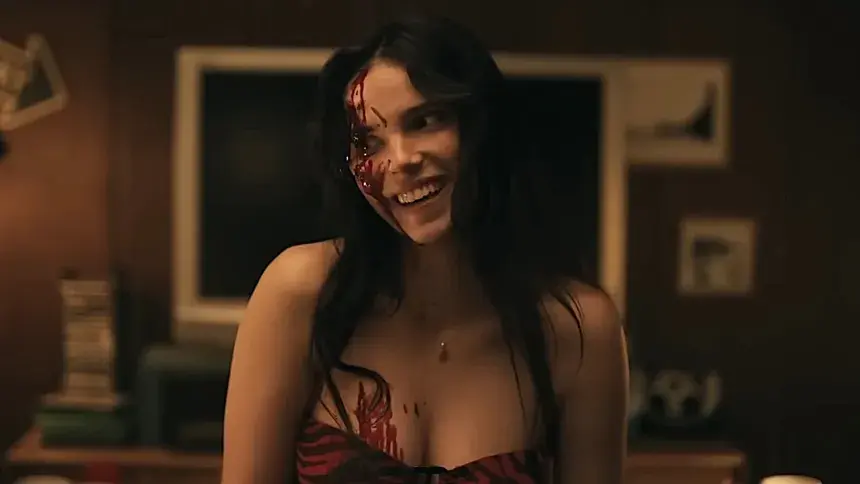
Inde Navarrette in Curry Baker's "Obsession"
There is something slightly unhinged about making an independent film.
You spend money you probably don't have, ask people to give up nights and weekends, turn your apartment into three different locations, and convince yourself that the mysterious buzzing ruining every take is definitely fixable in post.
All because you cannot stop thinking about an idea.
That kind of obsession can be useful.
This month, Obsession became one of the clearest examples of what can happen when a filmmaker stops waiting for the industry to invite them in and starts making the work anyway (and if you're jumping to the comment section to talk about the crew...don't worry...we'll get to that).
Curry Barker’s horror film was reportedly made for around $750,000. It premiered at the Toronto International Film Festival, was acquired by Focus Features in a deal reported at approximately $15 million, and has now earned nearly $340 million worldwide.
$750K into $430M. That is an extraordinary result.
It is also not a story about someone appearing out of nowhere.
Before Obsession, Barker and his longtime collaborator Cooper Tomlinson spent years making comedy sketches and horror shorts for the internet. When they could not find a distributor for their $800 feature Milk & Serial, they released the entire film on YouTube for free.
It went viral.
The movie that could have sat unseen on a hard drive became proof that Barker could make something specific, hold an audience for more than an hour, and follow through on his ideas. It helped lead to representation, industry relationships, Obsession, and everything happening now.
He did not wait for someone to become obsessed with his potential.
He became obsessed with the work.
Obsessed much?
Being obsessed doesn't mean become so consumed with yourself that every conversation somehow circles back to your IMDb page.
It means care about your creative life enough to actively build it.
Write the scene.
Gather the people.
Shoot the short.
Watch the footage.
Notice what does not work.
Do it again.
Actors spend an enormous amount of time waiting to be selected. Submitting, auditioning, updating materials and hoping someone else sees a place for us.
That is part of the career. It cannot be the entire career.
Making independent work gives you somewhere to practice your craft under real conditions. You discover whether you can sustain a character beyond one audition scene. You see how your choices read once they are edited together. You learn what kind of material actually suits you—and what excites you enough to keep going when the process feels like too much.
You also begin building the relationships that make future work possible.
No film is truly made alone.
Not your three-minute comedy about an actor slowly losing their mind during a self-tape.
And certainly not Obsession.
It takes a village. And how you treat that village matters (told ya we'd get to it).
Remember me?
As Obsession became a massive box-office hit, the film’s art director, Sally Choi, publicly discussed her experience working on it.
Choi said she was paid $300 per day and earned $6,741.36 after taxes. She also said her official title did not reflect the number of jobs she performed, which included work as a set dresser, production assistant, graphic designer, buyer, driver and background actor.
According to Choi, some crew members volunteered in exchange for gas and mileage reimbursement, and some of those reimbursements were delayed.
She acknowledged that she knew the rate and agreed to it beforehand.
That fact matters. It does not, however, end the conversation.
The internet did what the internet does — split immediately into two teams. One side: she agreed to the rate, she knew the budget, that's indie filmmaking. The other: a $337 million film was built on the backs of people who couldn't cover their rent.
Barker responded through The Hollywood Reporter, praising the art department and acknowledging the reality plainly: "This movie was made for so little money that it's typical that the only people who directly benefit from its financial success are the people who took on some sort of risk." His hope was that the movie would create financially valuable career opportunities for its crew, as it had for him.
That is a real part of independent-film economics.
But exposure, credit and possible future employment are not the same as compensation. And one could certainly argue that the risk isn't always financial. Risk can be devoting valuable time (and blood, sweat, and tears) to a project for little (or no) reward. That can also be a substantial risk. We all have bills to pay, after all.
It's true. A production made for $750,000 cannot operate like a $75 million studio film. The filmmakers were working with severe limitations and taking a major financial risk. No one involved could have known that the movie would become one of the year’s biggest hits.
It is also true that “you agreed to it” can be an incomplete response when people accept low rates because they need the money, need the credit, believe in the project or worry that saying no means losing the opportunity entirely.
It is also important to remember that nearly $340 million in box-office revenue is not the same as $340 million in profit. Theaters, distributors, marketing expenses, investors and other participants all sit between a ticket sale and whatever money ultimately remains.
Still, the controversy raises a question every actor-turned-creator should consider:
If you are asking people to help build your dream — to show up for and believe in you before anyone else does — what responsibility do you have to them?
Ethical ≠ expensive.
The following is not directly tied to Barker's production. Obsession was used as an example to open an important conversation surrounding independent filmmaking.
Let's be clear: most indie productions cannot offer everyone union scale, a luxury trailer and a surprise backend bonus on their first project.
But they can offer honesty.
Before anyone agrees, tell them what the project is, what you can pay, how many hours you expect, what their actual responsibilities will be and how the work may eventually be used.
If the position is unpaid, say that plainly.
If one person will be covering three jobs, say that before the shoot—not when they arrive and discover they are also carrying equipment, dressing the set and driving everyone home. If things change (and they often do), acknowledge these changes!
Reimburse agreed expenses promptly.
Feed people.
Schedule reasonable hours.
Give accurate credit.
Get ownership agreements and releases in writing.
Discuss whether everyone can use the footage in their reels and portfolios.
If you are offering deferred payment, profit participation or a bonus if the project sells, define what that actually means. “We will all get rich when Netflix calls” is not an accounting system.
And if the project unexpectedly succeeds, consider how you might share that success—even if you are not contractually required to do so.
That could mean a bonus.
It could mean rehiring the same people at better rates.
It could mean making introductions, publicly recognizing their contributions or actively helping them turn the credit into another opportunity.
The important thing is not treating people as disposable because they believed in your vision before anyone else did.
Your ambition is not unethical.
Building your ambition on other people’s silence, confusion or financial/career desperation can be.
What do I do with my obsession?
Barker and Tomlinson tried to find a traditional home for Milk & Serial. When that did not happen, they put it directly on YouTube.
That decision did not immediately give them a theatrical release.
It gave them something they needed first: An audience.
Per Nielsen, YouTube has led U.S. TV watch time for over a year straight. Last year its total revenue topped $60 billion, more than Netflix. And YouTube has been paying individual creators ad revenue since 2007. Nearly two decades of monetization infrastructure — and most actors still treat it like it's for other people. In 2026, to qualify for full ad revenue through the YouTube Partner Program, you need 1,000 subscribers and either 4,000 watch hours in the past twelve months or 10 million Shorts views in ninety days. There's an earlier access tier — channel memberships, Super Thanks — at just 500 subscribers and 3,000 watch hours.
Those goals require work.
Uploading one short film does not create a sustainable business over night.
But the infrastructure exists.
Then there's YOW.tv — launched by independent filmmakers who got tired of watching their work disappear into the void of giant platforms. Boutique streaming, built specifically for indie content. No gatekeepers, no predatory contracts, creators retain ownership, transparent earnings. Filmmakers choose their own pricing — rental, purchase, or ad-supported free — and submit directly. It's not trying to be Netflix. It's trying to be the thing Netflix was never going to be for independent work.
Then there are festivals, Filmhub, community screenings, direct rentals, your own website and platforms serving specific genres or audiences.
And earlier this month, Instagram announced that it is exploring longer-form creator work and episodic series for its television app.
The distribution system is there.
The monetization possibilities exist.
Every project you finish is a chance to build an audience, add to a body of work, create opportunities for yourself (and your village), and take one more step toward a career that belongs to you.
Focus for July: Get obsessed
Stop waiting. Start doing.
One scene. One short. One episode — three minutes, a character, a world, an ending that makes someone want to see what happens next. You and one other person, shot on a phone, edited on a laptop.
The point is threefold.
You find out things about yourself as a performer that a class can't teach you. When you're making the choices — not waiting for a director to hand them to you — you learn what you actually do with creative control.
You build the village. The actor you shoot a scene with, the writer who hands you a strange character to explore, the filmmaker who needs a cast — those aren't networking contacts. They're your production infrastructure. Your future collaborators. You build those relationships by making things together, and you build them with integrity.
You put your training to the test. There's a real difference between sharpening a skill in a safe room and using it under real conditions — when your name is on something, when real people are going to watch it. You find things in the test you don't find in practice.
So, go do the work.
Then find it a home.
